
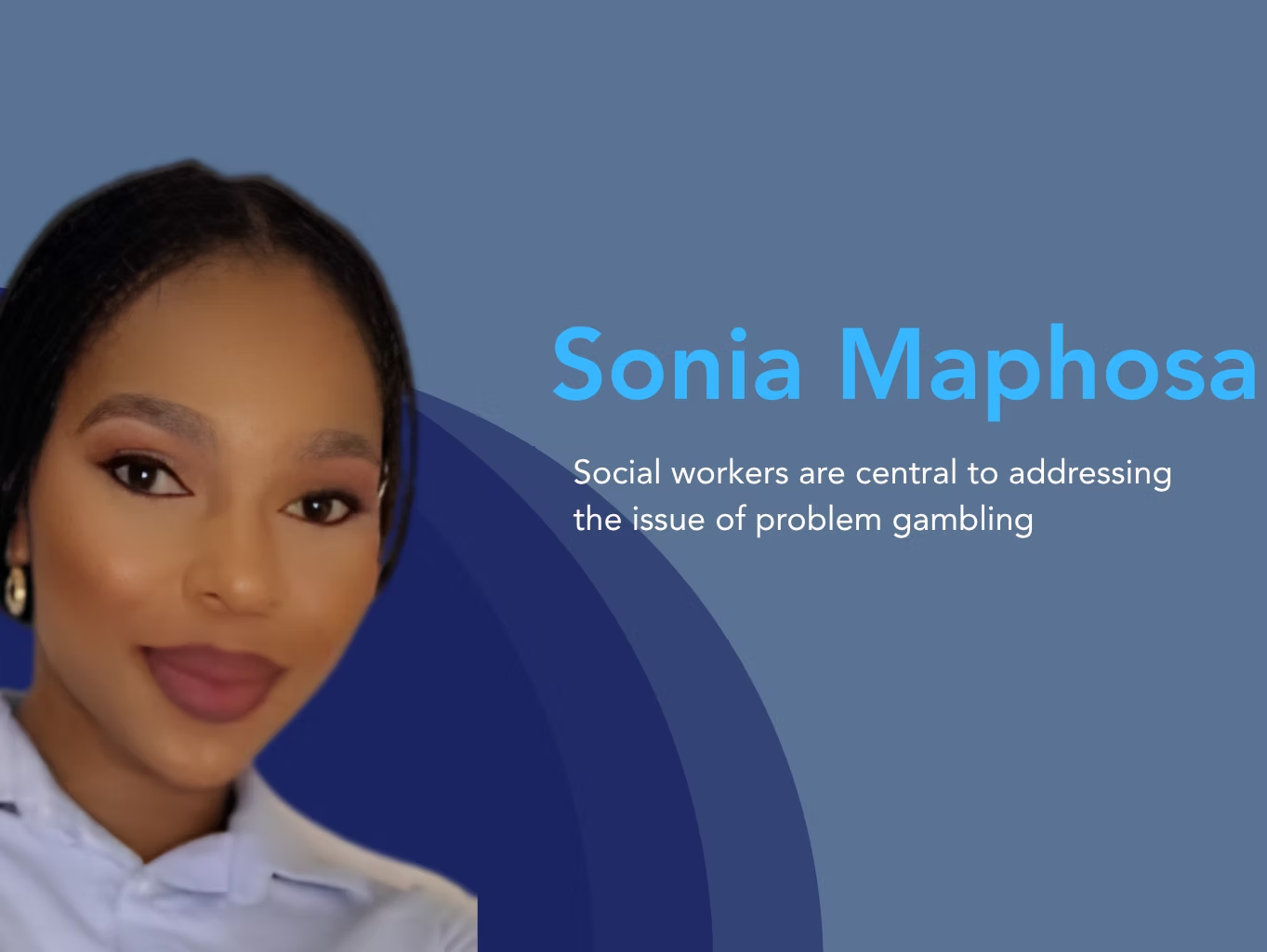
Sonia Maphosa
March is Social Work Month, and if there is one thing I wish South Africans understood better, it is this: when gambling stops being entertainment and starts becoming a lifeline people cling to, social workers are often the very first people they turn to.
I see this every day in my work at the South African Responsible Gambling Foundation. People do not arrive saying, “I have a problem with gambling.” They arrive saying, “I don’t know what to do anymore.” They come when the bank account is empty, when rent is overdue, when relationships are strained to breaking point, when trust within the family has eroded, and when shame has become their constant companion.
In South Africa’s current socioeconomic reality, this is hardly surprising. High unemployment, rising living costs, deep inequality and ongoing financial insecurity have created an environment where gambling is increasingly seen as a possible solution rather than risky behaviour. When this is combined with easy access to online betting platforms that are available around the clock, often on a cellphone, desperation meets opportunity and the results can be devastating.
Social workers are on the frontlines of this crisis. We encounter students who gamble away their NSFAS money in the hope of making it last longer or grow. We work with minors who use their parents’ ID numbers to access betting sites. We see elderly people misusing pension money, and employed individuals who feel their salaries are no longer enough to sustain their households. Problem gambling does not discriminate. It cuts across age, income, education and employment status.
What is often missing from public conversations about gambling is that it rarely exists on its own. By the time someone reaches a social worker, gambling is usually intertwined with other pressures such as debt, substance use, depression, anxiety, unresolved trauma, family conflict and social isolation. Gambling becomes a coping mechanism, a way to escape stress or emotional pain, even if only for a short while. That relief does not last. The consequences do.
Financial ruin is often the most visible outcome, but it is only one part of the damage. Families begin to fracture under the weight of secrecy, dishonesty and broken promises. Relationships suffer as trust is repeatedly undermined. Children are affected when money meant for food, school fees or transport is lost. Emotionally, people can become trapped in cycles of guilt, shame, anxiety and hopelessness that reinforce the very behaviour they want to stop.
This is where social workers play a vital role as a first line of defence. We are trained to identify early warning signs, often before a situation turns into a full-blown crisis. To do this, we use structured guidelines to help us understand whether gambling has moved from occasional behaviour to something harmful.
One of the key tools we use is the DSM-5, which is a globally recognised manual that outlines patterns of behaviour linked to different mental and behavioural disorders. It helps us identify whether gambling is starting to take control of someone’s life. It looks at indicators such as an inability to stop or cut back on gambling, chasing losses, lying to loved ones about gambling, gambling with money meant for basic needs, becoming restless or irritable when trying to stop, and continuing to gamble despite clear harm to relationships, work or finances.
Social workers do not use this tool to diagnose clients. Our role is not to label people. Instead, the DSM-5 helps us recognise warning signs, assess risk, and understand the severity of the problem. It gives structure to conversations that might otherwise feel overwhelming, allowing us to ask the right questions and identify when someone needs specialised support.
Our work does not stop with the individual. Gambling harms ripple outward, affecting partners, parents, children and extended family members. Social work interventions take these relationships into account, helping families understand the addiction, set boundaries, and begin the difficult process of rebuilding trust. Recovery is not only about stopping gambling. It is about repairing lives and relationships that have been deeply disrupted.
One of the hardest realities for clients and their families to accept is that recovery is not linear. There are setbacks and relapses. Motivation shifts. Progress can be uneven and slow. Social workers walk alongside people through this process, helping them manage shame, rebuild a sense of identity, and reconnect with who they were before gambling took control. Meaningful change takes time, patience and consistent support.
Motivation plays a crucial role in recovery. When people acknowledge their gambling problem and engage voluntarily in therapy, outcomes improve significantly. When change is driven mainly by external pressure, such as fear of losing a partner or family support, progress is often more fragile. Social workers are trained to work within this complexity, meeting people where they are rather than where we think they should be.
As we reflect on Social Work Month, it is important to recognise that social workers are not an optional extra in addressing problem gambling. We are central to prevention, early intervention and long-term recovery. Since July last year, more than a hundred social workers have been trained to identify gambling-related harm and make appropriate referrals, strengthening the country’s ability to respond at community level.
South Africa is facing challenges that cannot be solved overnight. Poverty, inequality and unemployment will not disappear tomorrow. But social work is about limiting the harm these realities cause in people’s lives. It is about being present when individuals feel lost and helping them see that support exists.
For me, social work is about being part of the solution. And when it comes to problem gambling, social workers remain one of our strongest and most human lines of defence.
Sonia Maphosa is Assistant Manager: Harm Reduction and Social Services at the South African Responsible Gambling Foundation.